Serving united states & surrounding areasMon–Fri 8am–6pm · Sat 9am–2pm
AI consultant pricing · United States
How much does an AI consultant cost?
Get clear 2026 price ranges for hourly help, fixed-scope projects, and monthly retainers, plus what typically drives cost up or down for small businesses in the United States.
How Much Does an AI Consultant Cost in the United States?
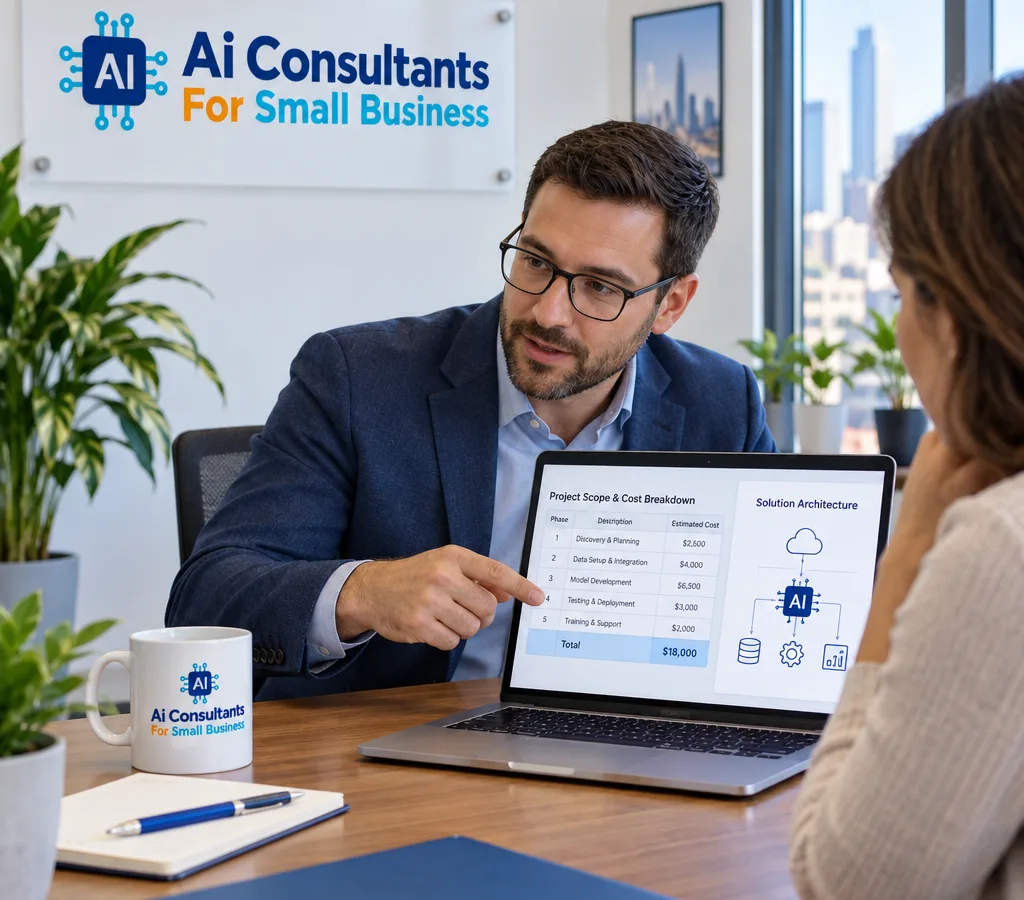
In 2026, an AI consultant cost in the United States typically ranges from about $150 to $350 per hour, with fixed-scope projects commonly landing around $5,000 to $40,000+, and monthly retainers often running $3,000 to $15,000+ depending on how much delivery work is included. Small advisory engagements sit at the low end; custom integrations, data work, and ongoing optimization move you up the range.
Final pricing depends on scope (advice vs build), the number of systems involved (CRM, accounting, support desk), data readiness, security and compliance needs, and whether you need change management and training. Exact costs are confirmed after a scoping call and a written statement of work.
What you actually pay for (and what you should get)
When people ask, “How much does an AI consultant cost?”, what they usually want is predictability: what the money buys, how long it takes, and what the deliverable looks like.
A practical engagement, not tool access
A well-run AI engagement for a small business is not priced on hype or tool access. It is priced on the work required to choose the right use case, make your data usable, integrate with the systems you already run, and deploy something your team will adopt.
Discovery and scope
Short interviews, process mapping, and a written scope that lists what is in and out.
Use-case selection and ROI logic
A prioritized list of opportunities with the assumptions written down.
Data and access review
What data exists, where it lives, who owns it, and what needs cleanup or governance.
Architecture and tool selection
Choosing between existing AI features, a light custom build, or a deeper integration.
Implementation, safeguards, and enablement
When included, this can cover workflow automation, API integrations, prompt and evaluation design, retrieval setup, testing, access controls, retention, audit trails, training, playbooks, and handoff.
If you are comparing providers, anchor on deliverables. Hourly rate matters, but a clear scope and measurable acceptance criteria matter more.
Most small businesses end up choosing one of three pricing models. Each can be fair, as long as scope and decision rights are written down.
Hourly consulting (typical: $150 to $350 per hour)
Best for second opinions, troubleshooting, vendor evaluations, and short strategy work. Ask for an estimate of hours by phase (discovery, design, implementation support) and what triggers a change in that estimate.
Fixed project pricing (typical: $5,000 to $40,000+)
Best when you want a defined outcome: an AI roadmap, a working prototype, an integration, or a deployment with training. Fixed-fee work should include a statement of work, assumptions about your systems and data, and what counts as “done”.
Monthly retainers (typical: $3,000 to $15,000+ per month)
Best when you want ongoing iteration: monitoring quality, improving prompts and evaluations, adding automations, and supporting your team. Retainers vary widely based on whether your consultant is advising, building, or effectively acting as your outsourced AI lead.
For an overview of how our team structures engagements for small companies, Ai Consultants For Small Business describes the typical ways we scope and support work.
Common deliverables by price tier (small business reality check)
$1,500 to $5,000: advisory sprint
A focused assessment, a prioritized shortlist of use cases, tool recommendations, and a written plan for the first implementation. Usually limited implementation work.
$5,000 to $15,000: roadmap + pilot build
A scoped pilot, such as a support assistant with a controlled knowledge base, plus basic evaluation and team training. Integration depth is usually light.
$15,000 to $40,000: production deployment
A live workflow with real integrations, access controls, monitoring, and handoff documentation. More time goes into data cleanup and testing.
$40,000+: multi-system or high-risk work
Multiple departments, deeper integrations, higher compliance needs, or custom application work. Expect more formal requirements, security review, and change management.
Retainer add-ons (monthly)
Ongoing model and prompt evaluation, incident response, new use-case rollouts, adoption support, and vendor management. The more systems and teams involved, the larger the retainer.
What drives AI consultant cost up (and how to control it)
AI consulting is expensive for the same reason any good technical work is expensive: it involves judgment, careful testing, and coordination across people and systems.
If your information is scattered across shared drives, inboxes, PDFs, and tribal knowledge, expect more cost. Good consulting teams spend real time defining sources of truth, access rules, and update processes.
Integrations and permissions
Connecting AI to your CRM, ticketing, accounting, scheduling, or inventory tools often takes longer than building the prompt itself. Permissions and least-privilege access are where many projects bog down.
Reliability requirements
An internal FAQ assistant is different from a system that touches customer communications or order changes. Revenue-impacting actions need more testing, guardrails, and human review.
Security, compliance, and adoption
Regulated records add vendor review, data-handling rules, audit trails, and retention policies. Training, playbooks, and role-based guidance also matter because a technically correct tool that the team does not use is wasted money.
Ways to keep the budget under control
✓Start with one workflow that has clear inputs and outputs.
✓Decide upfront who owns approvals and content updates.
✓Favor controlled knowledge sources and retrieval over pasting sensitive data into prompts.
✓Use a staged rollout: prototype, pilot, production.
If your bigger question is whether to outsource build work or train your team to run it, AI consulting services for small business can help frame the decision without forcing a one-size-fits-all approach.
From intake to handoff
How pricing is scoped with Ai Consultants For Small Business
Step01
Short intake and goal definition
We clarify the workflow you want to improve, what success looks like, and what systems or people are in the loop. This prevents paying for a tool that does not match the job.
Step02
Data and system inventory
We list the sources that matter, confirm access, and identify any cleanup or governance needed before AI can be reliable.
Step03
Scope and pricing options
You receive a written scope with assumptions and a recommended pricing model: hourly, fixed project, or retainer. We also separate must-haves from nice-to-haves.
Step04
Build or support delivery
If implementation is included, we deliver the agreed artifacts and iterate based on testing, not gut feel.
Step05
Handoff and ongoing support plan
We document what was built, how to maintain it, and who owns updates. If you want ongoing help, we define what is included each month and what becomes a separate project.
“The most helpful part was the written scope. We stopped guessing, picked one workflow to start with, and the pricing finally made sense because every line item mapped to an actual deliverable.”
“We had quotes all over the place. Once we compared what each consultant included for data cleanup, integrations, and training, the differences in cost were easy to explain to our leadership team.”
Common questions
AI consultant pricing FAQs (2026)
How much does an AI consultant cost for a small business project?+
Most small business AI projects in 2026 land between about $5,000 and $40,000+, depending on whether you are buying strategy only, a pilot, or a production deployment with integrations and training. A clear statement of work matters more than the headline number because scope changes are what usually expand budgets.
Is hourly or fixed-fee better for AI consultant pricing?+
Fixed-fee is usually better when you can define the deliverable and want budget certainty, while hourly is better for short advisory work and troubleshooting. If you choose hourly, ask for an estimated range of hours by phase and require a written update before work goes beyond that range.
What should be included in an AI consulting quote?+
A good quote includes a written scope, assumptions about your systems and data, deliverables, timeline, roles, and acceptance criteria. For implementation work, it should also spell out security expectations, testing or evaluation, and what training or documentation is included.
Why do AI consultant hourly rates vary so much?+
Rates vary based on what you are buying: strategy-only advising is priced differently than hands-on engineering, integrations, data governance, or compliance-heavy work. Industry experience and the ability to deliver a clear scope quickly also affect rate because they reduce rework.
Can we use off-the-shelf AI tools to lower cost?+
Yes, and it often is the right move for small businesses, as long as you are clear about data access, retention, and who can see what. Off-the-shelf tools can reduce build cost, but you may still need consulting time for setup, permissions, knowledge source curation, and training.
Do retainers make sense, or should we do one project at a time?+
A retainer makes sense when you expect ongoing iteration and support, such as monitoring answer quality, adding workflows, maintaining integrations, and supporting team adoption. If you only need a one-time roadmap or a single pilot, a fixed project is usually cleaner.
Get a clear scope and a realistic 2026 budget
Share what you want AI to improve and what tools you already use. We will outline practical options, likely cost drivers, and the right pricing model before any build work starts.